Category: Validation

  • What Are Validation Services? Everything You Need to Know

    What Are Validation Services? Everything You Need to Know

    In today’s highly regulated world, businesses, especially those in pharmaceuticals, biotechnology, medical devices, food, and software, must prove that their processes work exactly as intended. This proof isn’t optional; it’s the backbone of compliance, quality, patient safety, and long-term trust.

    That’s where Validation Services come in.

    Validation is more than documentation or technical tests. It’s a disciplined, structured approach to ensuring products, systems, and processes perform reliably every single time. Whether you’re launching a new system, upgrading legacy equipment, or preparing for an FDA audit, validation services protect your organization from costly risks and bring peace of mind that everything is running safely and consistently.

    In simple words: Validation Services help you show evidence that what you build, manufacture, test, or automate is actually working and that it can stand up to regulatory scrutiny.

    Why Validation Services Matter

    For many teams, validation can feel overwhelming. There are documents, audits, protocols, templates, and shifting regulatory expectations. Yet, at its core, the goal is simple:

    1. To ensure processes are repeatable
    2. To ensure systems are accurate
    3. To ensure products are safe

    When done right, validation creates confidence—for manufacturers, regulators, employees, and most importantly, customers.

    Types of Validation Services

    Different industries require different types of validation. Here’s a simplified breakdown to help you understand how they work and where they apply.

    1. Computer System Validation (CSV)

    This ensures software and computerized systems used in regulated environments work correctly and consistently.

    Used for:
    1. Laboratory systems
    2. Manufacturing execution systems
    3. ERP, LIMS, QMS, CRM
    4. HRMS and medical systems
    5. Electronic batch records

    CSV evaluates whether the system meets user requirements, regulatory expectations (like FDA 21 CFR Part 11), and data-integrity principles.

    2. Process Validation

    This confirms that a manufacturing process can reliably produce quality products across multiple batches.

    Used in:
    1. Pharmaceuticals
    2. Biologics
    3. Medical devices
    4. Food manufacturing

    Process validation is usually performed in three stages:

    1. Process Design
    2. Process Qualification
    3. Continued Process Verification

    3. Equipment Qualification (IQ, OQ, PQ)

    This verifies equipment performance through Installation, Operational, and Performance Qualification tests.

    Quick Overview Table

    Qualification StageWhat It ChecksExample Activities
    IQ – Installation QualificationWas the equipment installed correctly?Utility checks, component verification
    OQ – Operational QualificationDoes it work within defined limits?Functionality tests, alarms, controls
    PQ – Performance QualificationCan it perform under real conditions?Batch runs, performance consistency

    4. Cleaning Validation

    Ensures that cleaning procedures remove contaminants, residues, and microorganisms from equipment surfaces.

    • Essential for:
      1. Pharmaceutical manufacturing
      2. Nutraceuticals
      3. Sterile products
      4. Chemical processing

    Cleaning validation protects patients and prevents cross-contamination.

    5. Method Validation

    Verifies that laboratory testing methods are accurate, precise, specific, repeatable, and robust.

    6. Data Integrity Validation

    This ensures data is complete, consistent, and accurate from creation to archival.

    Focused on ALCOA+ principles:
    Attributable, Legible, Contemporaneous, Original, Accurate + Complete, Consistent, Enduring, Available

    Why Companies Use Validation Services

    Here are the most common reasons organizations rely on professional validation experts:

    • Regulatory Compliance

    FDA, EMA, MHRA, WHO, and other regulators demand well-validated systems and processes.

    • Risk Reduction

    Validation minimizes the chances of product failure, recalls, or compliance violations.

    • Audit Preparedness

    Having proper validation documentation helps you pass audits with confidence.

    • Operational Efficiency

    Validated processes reduce downtime, errors, and rework.

    •  Improved Product Quality

    Every customer receives a safe, consistent, reliable product.

    How Validation Services Usually Work

    Here’s a simplified end-to-end flow of how a validation project is executed:

    1. User Requirement Specification (URS)

    Define what the system or equipment must do.

    2. Risk Assessment

    Identify what could go wrong and prioritize critical parameters.

    3. Validation Plan

    Create a roadmap for documentation, testing, and responsibilities.

    4. Protocol Development

    Prepare IQ, OQ, PQ, CSV protocols, test scripts, templates, etc.

    5. Execution

    Perform the actual testing and evidence gathering.

    6. Deviations & Resolutions

    Investigate failures, document root causes, and implement fixes.

    7. Final Report

    Summarize findings and provide documented proof of validation.

    A Simple Comparison Table

    AreaWithout ValidationWith Validation
    ComplianceRisk of violations, major audit findingsSmoother audits, clear documentation
    Product QualityInconsistent batchesPredictable quality
    Operational StabilityFrequent breakdowns or failuresReliable performance
    Risk ExposureHigh recalls, customer complaintsMinimized risks
    TrustReduced credibilityHigher customer and regulatory trust

    Industries That Rely on Validation Services

    Validation is essential across a wide range of fields:

    1. Pharmaceuticals & Biotech
    2. Medical Devices
    3. Food & Beverage
    4. Cosmetics
    5. Healthcare & Hospitals
    6. Software as a Medical Device (SaMD)
    7. Laboratories
    8. Manufacturing Industries

    Whether it’s automated equipment, lab instruments, new machinery, or cloud-based systems, validation ensures everything works exactly as intended.

    Key Highlights & Pointers

    Here are some quick pointers that make validation easier to understand:

    • Validation is not a one-time activity it’s ongoing.
    • Documentation is just as important as testing.
    • Every validation must be risk-based, not overly complicated.
    • Data integrity is a core requirement in all validation projects.
    • Automation and advanced digital tools are improving validation timelines.
    • A validated system must be maintained, reviewed, and monitored regularly.

    A More Human Perspective: Why Validation Matters

    Behind every medicine that a patient takes, behind every medical device, behind every safety report or laboratory test—there is a system responsible for that accuracy.

    People can get hurt when systems fail.

    At the root, validation is the protection of people. It makes sure that every pill, every medical device, every batch, and every dataset has been made with due care, precision, and accountability.

    For manufacturers, validation eliminates the guesswork. For auditors, it provides traceability. For employees, it brings confidence. And for customers, it builds trust.

    That is why validation services are much more than technical tasks; they are quality guardians.

    Conclusion

    Validation provides the core of quality assurance in highly regulated industries. Whether one is implementing a new system, scaling up manufacturing, launching a medical device, or preparing for an audit, validation ensures that everything performs consistently and safely.

    Whether your organization is seeking stronger compliance, better product quality, or operational efficiencies, engaging the right validation experts can transform the way you do business.
  • Cleaning Validation: Ensuring Equipment Cleanliness and Product Safety

    Cleaning Validation: Ensuring Equipment Cleanliness and Product Safety

    When it comes to pharmaceutical manufacturing, even minute details are important. Behind every product that reaches a patient, there is a lot of checking, controlling, and processing going on to protect the patients from harm. Among them, cleaning validation plays one of the most crucial roles.

    At face value, cleaning would appear rather uncomplicated, a matter of relatively simple concern: making the equipment look clean. In practice, cleaning validation is decidedly more complex: a scientific process that is methodical and thoroughly documented, aimed at proving that manufacturing equipment is cleaned deeply and well every time. The objective is rather basic: no residue, no cross-contamination, and no risk to the next batch or to the patient that depends on it.

    The U.S. FDA and other regulatory bodies, such as the EMA, place heavy emphasis on cleaning validation because it directly affects product quality and patient health. And in any GMP-compliant facility, a strong cleaning validation program isn’t just a good practice; it’s an expectation.

    What follows is a clearer, more approachable breakdown of what cleaning validation really means in day-to-day operations; tables have been included to help simplify and organize the key concepts.

    What Is Cleaning Validation?

    Cleaning validation is the documented evidence proving that a cleaning procedure consistently removes residues of active ingredients, excipients, cleaning agents, and microorganisms from manufacturing equipment.

    In other words, it verifies that:

    • The equipment is clean enough before starting the next batch
    • No harmful residue remains.
    • The cleaning process is repeatable and scientifically justified

    This helps maintain product quality and protects patients from unexpected exposure to chemical or microbial contaminants.


    Why Cleaning Validation Matters

    Key Reasons for Cleaning Validation

    ReasonWhy It Matters
    Prevent Cross-ContaminationEven tiny residues can harm patients, especially with potent or allergenic drugs.
    Regulatory RequirementFDA, EMA, and WHO expect robust cleaning validation as part of GMP compliance.
    Ensures Product SafetyPrevents impurities, degradation products, or microbes from entering the next batch.
    Maintains Equipment ReliabilityConsistent cleaning reduces downtime and prevents buildup that may impact machinery.
    Avoids Recalls or Legal IssuesStrong programs reduce the risk of regulatory citations, recalls, and financial loss.

    Strong cleaning validation isn’t just about compliance; it protects patients and preserves a company’s reputation.

    Key Components of a Cleaning Validation Program

    A thorough program combines risk assessment, scientific justification, employee training, and continuous monitoring.

    Major Components of a Cleaning Validation Program

    ComponentDescription
    Risk AssessmentIdentifies potential contamination risks, product potency, equipment challenges, and cleaning difficulties.
    Acceptance CriteriaDefines the maximum allowed residue limits based on toxicology and health-based exposure limits.
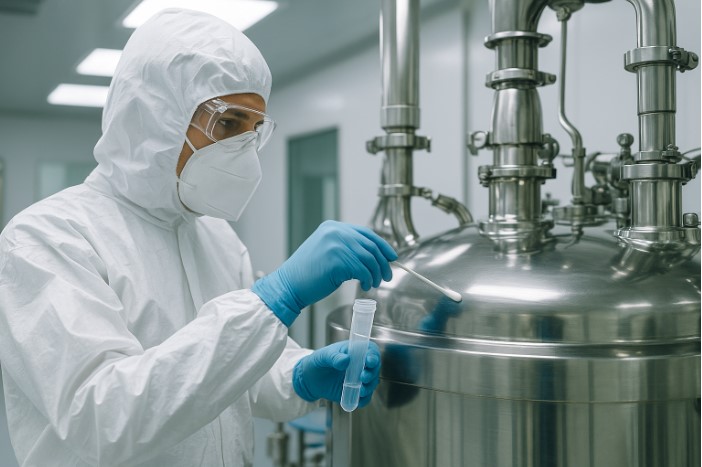
    Sampling MethodsIncludes swab sampling for surfaces and rinse sampling for overall cleanliness.
    Analytical Method ValidationTechniques such as HPLC, TOC, or UV must be validated to detect trace residue accurately.
    Validation RunsTypically, three consecutive successful cleaning cycles prove repeatability.
    DocumentationComplete evidence protocols, results, deviations, and reports must be recorded for audit readiness.

    Each component plays a role in making the validation process scientifically defensible and compliant.

    Types of Sampling Used in Cleaning Validation

    Two main sampling approaches help verify cleanliness.

    Comparison of Sampling Methods

    Sampling MethodHow It WorksBest Used For
    Swab SamplingA sterile swab is rubbed on defined equipment areas to collect residue.Hard-to-reach areas, surface hotspots, and direct residue detection.
    Rinse SamplingThe rinse water from the equipment is tested for dissolved contaminants.Large surface areas, inaccessible equipment parts, and recovery of soluble residues.

    In many cases, both sampling methods are used together to provide a complete picture of equipment cleanliness.

    Acceptance Criteria in Cleaning Validation

    Acceptance limits are determined based on toxicity, potency, batch size, equipment surface area, and cleaning capability.

    Factors Affecting Acceptance Limits

    FactorImpact on Cleaning Limits
    Potency of APIMore potent drugs require stricter limits.
    ToxicityHigher toxicity demands lower allowable residue.
    Batch SizeLarger batches may dilute residue, influencing limits.
    Equipment Surface AreaLarger areas require proportional calculations for MACOs (Maximum Allowable Carryover).
    Cleaning AgentResidue of detergents or solvents also needs a limit justification.

    Modern guidance encourages using Health-Based Exposure Limits (HBELs) for scientific limit-setting.

    Best Practices for Effective Cleaning Validation

    An effective program is built on consistency, scientific data, and continuous improvement.

    Best Practices Summary

    Best PracticeWhy It Matters
    Apply Lifecycle ApproachEnsures validation continues after initial qualification.
    Assess Equipment DesignIdentifies areas that are difficult to clean.
    Select Suitable Cleaning AgentsShould remove residues effectively without damaging equipment.
    Train Operators ThoroughlyReduces human error and improves consistency.
    Conduct Periodic MonitoringEnsures cleaning remains effective over time.
    Use Digital SystemsElectronic records improve accuracy, traceability, and audit readiness.

    These best practices help maintain compliance and reduce cleaning-related failures.

    Conclusion

    Cleaning validation isn’t just a box to be checked off in a pharmaceutical quality system; it’s one of the foundations that keep patients safe. When we perform cleaning process validations, we’re proving with real data that our equipment is truly clean, free from potentially harmful residues, and ready to manufacture the next batch without risk. It’s a scientific process, yes, but it’s also a reflection of our responsibility to every person relying on medicines produced by us.

    A strong cleaning validation program goes beyond meeting regulatory expectations: it’s a demonstration of corporate commitment to doing things right, consistently and transparently, while keeping patient safety at the center. When manufacturers take the time to build a thorough, well-documented, and risk-based approach, they aren’t just protecting their products but also the people who entrust them with their health.

  • Cleaning Validation in the Pharmaceutical Industry: Ensuring Every Batch Starts Clean

    Cleaning Validation in the Pharmaceutical Industry: Ensuring Every Batch Starts Clean

    Introduction

    When we think about pharmaceutical manufacturing, it’s very common to assume that the labs must be spotless. We think that all equipment must be very clean, and there must be people in cleanroom suits doing their work.

    But, in pharma, just looking clean is not enough. Even a few invisible particles left behind from the previous batch, or just a trace of an active ingredient left, can change what goes into the next product.

    To make sure no such incident happens, cleaning validation exists. This process is a scientific way of making sure that all equipment and the surface are free from any contamination.

    This process is a very important part of Good Manufacturing Practice (GMP). In fact, the FDA, EMA, and WHO take it seriously. They require manufacturers to show evidence that their cleaning process is safe and works well. 

    Let’s go through this article and understand what cleaning validation is and why it is important.

    Why Cleaning Validation Matters

    Cleaning validation is important because even the smallest contamination can put the entire product safety at risk. 

    A few traces of an active ingredient can cause cross-contamination.

    Leftover cleaning agents can react with the next product and change its chemical composition.

    There is also a chance of microbes building up between cleaning cycles. These microbes multiply fast and get into the next batch.

    There have been incidents like this:

    • Cholestyramine Recall (1988): Here, drug batches were contaminated because the solvent drums used earlier for pesticides weren’t cleaned properly. 
    • Penicillin Carryover Cases: Even microscopic traces of penicillin have caused allergic reactions in sensitive patients. These cases became so significant that regulators now require either dedicated equipment or cleaning levels so thorough that there’s no detectable residue at all.

    Global Regulatory Expectations

    Agency/RegionGuideline ReferenceKey Expectation
    FDA (USA)21 CFR 211.67Documented cleaning procedures and validation evidence
    EMA (Europe)EU GMP Annex 15, HBEL/PDE (2014)Science-based residue limits using toxicological data
    WHO / PIC/SGMP Annex on ValidationLifecycle validation and periodic re-validation
    ISPE / PDATechnical Reports 29 & 49Practical sampling, risk-based grouping, and data trending

    Building a Robust Cleaning Validation Program

    1. Validation Protocol

    Every cleaning validation program starts with a written protocol:

    • The scope and objectives of the validation
    • The equipment involved
    • The cleaning method (manual or automated systems like CIP/SIP)
    • The sampling plan and analytical methods to use
    • The acceptance criteria that define what “clean” really means

    2. Trained Personnel

    Only trained operators should perform cleaning and sampling. The thing is that missing any step can lead to contamination that can go unnoticed.

    3. Equipment Design

    You need to identify the hard-to-clean areas, like the gaskets, impellers, and spray balls. These are the places where residue remains.

    4. Cleaning Agents

    The cleaning agent you use should be free-rinsing, non-reactive, and easy to remove. But you also have to make sure that the detergent is also cleaned well after cleaning.

    5. Sampling Methods

    Most facilities use a combination of methods:

    • Swab sampling: For direct residue recovery on critical surfaces
    • Rinse sampling: It is for larger or harder-to-reach areas
    Sampling MethodBest ForDetection Limit
    Swab SamplingLocalized residuesHigh (µg/cm² range)
    Rinse SamplingInternal piping/vesselsModerate (mg/L range)
    Visual InspectionQuick pre-checkApprox. 1–4 µg/cm² visible threshold

    6. Analytical Techniques

    For analytical checking, different tools are used depending on the kind of residue you’re looking for:

    • HPLC/UV: It detects specific active ingredients or cleaning agents. 
    • TOC (Total Organic Carbon): This one measures the total amount of organic carbon in a sample and makes it sensitive to any kind of organic residue, not just the actives.
    • LAL (Endotoxin Test): It is used to detect pyrogenic or microbial contamination, especially critical for sterile manufacturing lines.

    7. Hold Time Validation

    Determine Dirty Hold Time (DHT): How long equipment can sit unclean.  Clean Hold Time (CHT): It is the time for which cleaned equipment remains safe before reuse.

    Both studies prevent microbial growth or residue hardening between processes.

    Setting Acceptance Criteria

    Criterion TypeTraditional LimitModern (Health-Based) Limit
    Dose-Based≤ 0.1 % of the previous product doseDerived from toxicological PDE/HBEL
    Concentration-Based≤ 10 ppm in the next productPDE-based MACO calculation
    Visual CleanlinessNo visible residueValidated visual residue limit (VRL)
    Cleaning Agent ResiduesNone detectedLimit based on manufacturer’s tox data

    Lifecycle Maintenance and Continuous Verification

    Cleaning validation doesn’t stop after three successful runs. It’s a lifecycle process that gets integrated into your site’s Contamination Control Strategy (CCS):

    Design → Validate → Monitor → Reassess → Improve

    You need to keep an eye on swab and TOC trends to find any issues early.

    Revalidate whenever there’s a change in product mix, cleaning agent, or equipment.

    Use risk-based grouping to handle multiple products efficiently.

    And also, keep your documentation secure. Missing data is one of the most common reasons the FDA issues citations.

    Conclusion

    I think Cleaning validation is a promise that every product leaving the facility is safe for the person who’s going to take it.

    You just have to use sensitive analytical methods and regularly review the process. That’s how manufacturers make sure that every piece of equipment starts clean and every batch stays safe.

    In today’s GMP world, it’s not enough to just follow the rules. You have to prove that your process works. 

    Real cleaning validation means protecting patients and earning trust.

  • Ensuring Quality Through Process Validation: Best Practices for Pharmaceutical Compliance

    Ensuring Quality Through Process Validation: Best Practices for Pharmaceutical Compliance

    Introduction 

    Quality is something that we expect to be in everything we use, be it the food we eat or the clothes we wear. But if we talk about the medicines we consume and the pharmaceuticals, quality is something that needs to be there from the very beginning, and not just in the end product. 

    There needs to be high standards of safety and efficacy in every step and procedure of pharmaceutical manufacturing. To make sure all the standards of safety and quality are met, process validation comes in.

    Pharmaceutical manufacturing goes through a lot of tests to ensure its quality. This process validation means proving that every step in the process delivers top quality.

    Now, process validation has evolved into a journey. It has become a cycle of understanding and improving. 

    This whole process teaches you something new every day and helps you improve your systems so that you are coming up with the best quality product every single time.

    Through this article, let’s understand how to ensure quality through process validation.

    1. What Is Process Validation and Why Does It Matter

    Process validation works as the proof that your manufacturing process works. It’s the scientific evidence that shows you can produce a product that meets all the specifications.

    It connects development knowledge with commercial reliability and protects both patients and manufacturers.

    If validation fails, there can be severe consequences.

    2. Global Regulatory Framework

    RegulatorKey FocusHighlights
    FDA (U.S.)3-Stage Lifecycle ApproachStage 1: DesignStage 2: Qualification (PPQ)Stage 3: Continued Process Verification (CPV)
    EMA (EU)Annex 15: Lifecycle + Risk ManagementValidation Master Plan (VMP) required; no retrospective validation
    WHO / ICHGlobal HarmonizationPromotes Quality by Design (QbD) and continuous verification

    All major regulators focus on a lifecycle model. They are now moving away from “three batches and done” toward continuous evidence of control.

    In one 2025 FDA warning, a company with unvalidated blending steps was ordered to do its entire process validation program again before distribution.

    3. Understanding the Process Validation Lifecycle

    Let’s understand the process validation life-cycle in a better way:

    StageObjectiveKey Deliverables
    Stage 1 – Process DesignDefine and understand the processCQAs, CPPs, risk analysis, control strategy
    Stage 2 – Process Qualification (PPQ)Demonstrate process consistencyIQ/OQ/PQ, PPQ batches, analytical results
    Stage 3 – Continued Process Verification (CPV)Maintain control during routine productionCPV reports, trend charts, CAPA actions

    Stage 1: Process Design

    This is the initial stage of the whole process. Here, you understand your product and design the whole process of how it is going to turn out.

    You start by identifying what defines quality. It is called Critical Quality Attributes (CQAs). You also identify the parameters that influence the quality – the Critical Process Parameters (CPPs).

    Here, you use tools like Design of Experiments (DoE) and pilot-scale data to get the process right. 

    Stage 2: Process Qualification

    Here, you validate your equipment and your operators. Then there is Process Performance Qualification (PPQ). In this, you have to run the process under predefined conditions, mainly three times successfully in a row.

    Stage 3: Continued Process Verification

    Then there is continuous verification. Here, the validation doesn’t stop once the PPQ is done. Instead, every single batch becomes part of an ongoing data stream.

    By regularly monitoring potency, dissolution, or bioburden, you can figure out small shifts early, before they turn into problems. 

    Stage 3 keeps your process healthy. Its goal is to find small issues before they become big problems.

    ParameterControl LimitCurrent MeanStatus
    Potency (%)95–105100 ± 2Stable
    Dissolution (%)≥ 80 in 30 min81 → 78Trend watch
    Bioburden (CFU/mL)≤ 104 → 5Stable

    4. Best Practices for Sustainable Compliance

    Focus AreaBest PracticeWhy It Matters
    Validation Master Plan (VMP)Define scope, ownership, and timelinesKeeps teams aligned and audit-ready
    Risk-Based FocusPrioritize high-impact process stepsAligns with ICH Q9, reduces over-testing
    Robust ProtocolsPredefine limits, include worst-case runsAvoids ambiguity during PPQ
    Cleaning ValidationChallenge with the hardest-to-clean residuesPrevents cross-contamination events
    Data IntegrityReal-time recording, secure audit trailsBuilds regulator confidence
    QA OversightQA approval at each lifecycle stageEnsures independence and compliance

    In 1988, unvalidated cleaning of reused drums led to pesticide contamination in cholestyramine resin. It is a recall that reshaped cleaning validation standards worldwide.

    5. Common Pitfalls and How to Avoid Them

    PitfallImpactPrevention Strategy
    Rushing PPQ without process understandingVariability, failed batchesPerform full DoE and risk analysis first
    Skipping CPVUndetected driftEstablish trending and alert limits
    Vague criteriaData ambiguityUse numeric, statistically justified limits
    Weak change controlLoss of validated stateReview and re-validate post-changes
    Poor documentationAudit findings, compliance riskFollow GDP, perform internal mock audits

    6. Documentation and Audit Readiness

    When you complete all the steps together, a complete process validation package shows how everything was done from start to end. It’s evidence that your entire system is under control.

    It includes:

    1. Validation Master Plan (VMP)
    2. Risk assessment and design data
    3. PPQ protocols, raw data, and reports
    4. CPV summaries and CAPA logs
    5. Change-control and re-validation records

    Conclusion

    Process validation is not just a regulatory requirement you have to follow. It is quite essential to keep the pharmaceutical quality good every day. It is a process that makes sure every pill and every vial is prepared and works the way it is supposed to.

    All you have to do is bring together good science and ongoing verification. This will lead to a good quality process and end products. Good end products mean good value, and they will create trust with the customers. 

    When you follow the whole process correctly, you will create a system that delivers safe and effective medicines every single time. 

    At the end of the day, process validation turns compliance into confidence. It changes regulations from something you have to do into something that keeps your products and your reputation up to the mark.