Category: Computerized System validation

  • Understanding the Basics of Computerized System Validation (CSV) in Pharma

    Understanding the Basics of Computerized System Validation (CSV) in Pharma

    Introduction

    In today’s pharmaceutical world, digital systems are important for every operation. They are important for things like manufacturing lines, quality testing and even for data recording and batch release. 

    When these systems are functioning well, they protect product quality and patient safety. But if they fail, a small error can turn into big compliance risks.

    That’s why Computerized System Validation (CSV) is important. CSV is the structured and documented approach that makes sure a computerized system works as it should.

    It also makes sure that it consistently delivers accurate data and fully complies with regulatory requirements. It gives companies the confidence that their digital systems are both reliable and audit-ready.

    Why CSV Matters in the Pharmaceutical Industry

    In pharmaceutical companies, there are strict regulations and the system that is used for GMP or GxP activities should be trustworthy. CSV ensures:

    • Patient safety: When systems are validated, they reduce the risk of errors that can affect product quality. This way it ensures safety of the patient.
    • Data integrity: Data integrity is another important thing. When roles are strong, they prevent data manipulation, misentry, and loss.
    • Regulatory compliance: If you fail to validate the system, it can result in FDA Warning Letters or production shutdowns.
    • Business continuity: When the systems are validated, it decreases downtime and protects valuable clinical and manufacturing data.

    Key Regulations and Guidelines You Must Know

    Here are some of the most important regulations and guidelines that you know about: 

    Regulation or GuidelineWhat It Covers
    FDA 21 CFR Part 11Requirements for electronic records and electronic signatures, including audit trails and access controls.
    EU Annex 11Lifecycle validation, data integrity rules (ALCOA+), risk management, supplier oversight.
    ISPE GAMP 5Industry best practice for risk-based validation, software categorization, testing depth, and scalable documentation.

    The CSV Lifecycle Explained

    CSV is a systematic lifecycle. Each phase gives evidence that the system is fit for use.

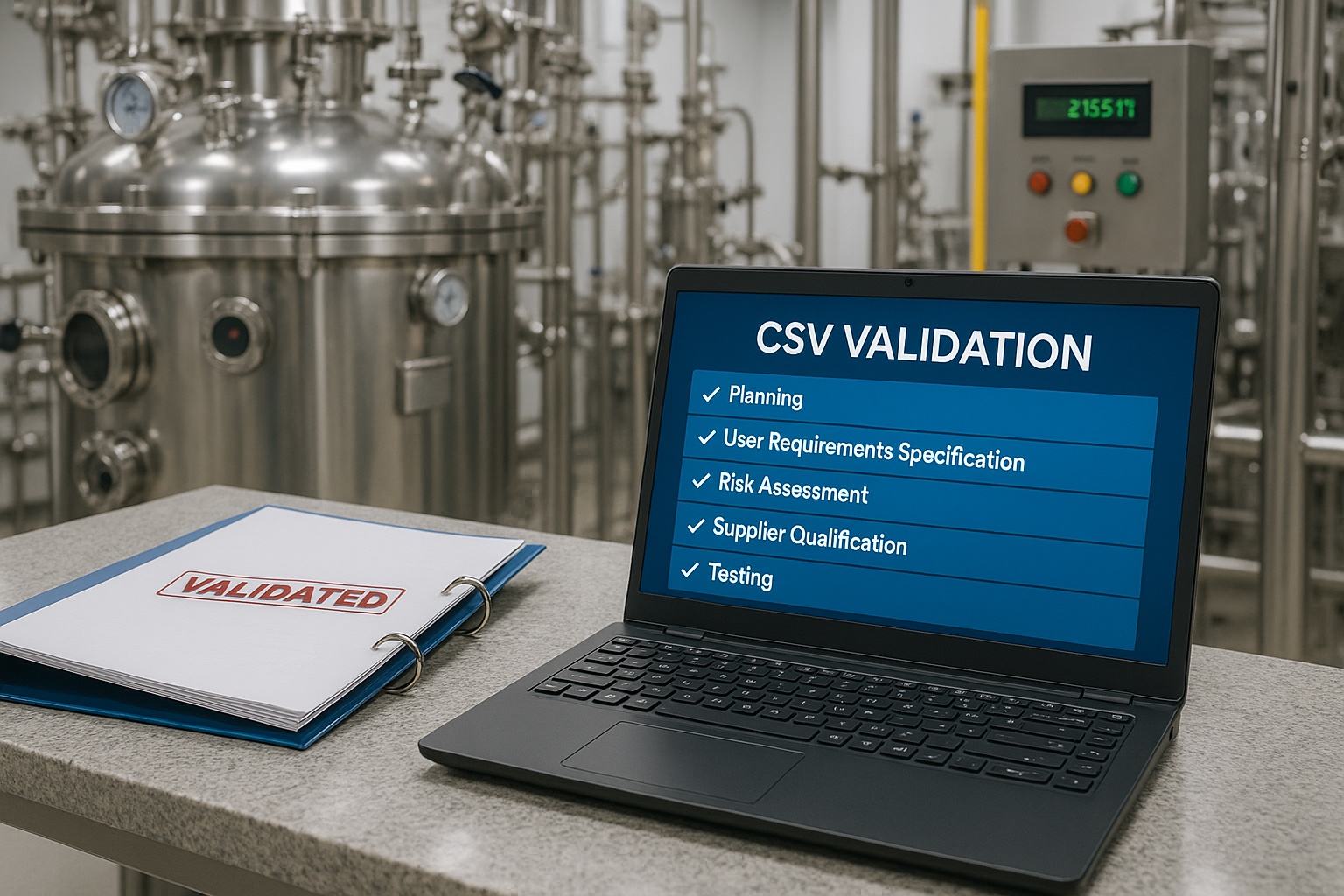
    1. Planning

    Planning is one of the most important aspects of anything. A CSV lifecycle starts with a proper plan. This plan tells about scope, responsibilities, timelines, validation strategy, and system criticality.

    2. User Requirements Specification (URS)

    URS states what the system is supposed to do. It includes functional needs, security, reporting, audit trails, and data handling.

    3. Risk Assessment

    Then comes the risk analysis. It helps in finding out what are the system functions that impact product quality or data integrity. Validation effort must be proportional to risk.

    4. Supplier Qualification

    Vendor audits are important for cloud or SaaS systems. Companies should evaluate the supplier’s development practices, cybersecurity controls, and service agreements.

    5. Design and Configuration

    System configuration or design is documented and mapped to user requirements.

    6. IQ, OQ, PQ Testing

    StagePurpose
    IQ (Installation Qualification)Verifies correct installation, environment setup, and system prerequisites.
    OQ (Operational Qualification)Test system functions, security, audit trails, error handling, and configuration.
    PQ (Performance Qualification)Confirms real-world performance in the production environment.

    7. Data Migration Validation

    All the data that gets moved from a legacy system needs to be checked for accuracy and integrity. That is called data migration validation.

    8. Validation Summary and Go Live

    A Validation Summary Report (VSR) is a report that compiles all evidence and provides final approval to operate the system.

    9. Ongoing Maintenance and Review

    Keeping on checking the maintenance and reviewing the work is very important. It includes training, SOPs, periodic reviews, change control for patches or upgrades, and cybersecurity monitoring.

    10. Decommissioning

    Then there is Decommissioning. You have to properly retire the data. It makes sure that the archived data remains accessible and audit-ready.

    What Gets Tested in CSV

    Proper testing in CSV, makes sure that the system always delivers secure and accurate results. Here is what gets tested in CSV: 

    Type of TestPurpose
    Traceability TestingEnsures all requirements are covered by test cases.
    Positive or Negative TestsVerify expected behavior and error handling.
    Security TestsConfirm access control, login rules, and password policies.
    Audit Trail TestingEnsures audit logs record user actions and cannot be altered.
    Backup or Restore TestingConfirms data recovery and business continuity.
    Interface TestingValidates accurate data exchange between systems such as LIMS and ERP.

    Common Pitfalls and How to Avoid Them

    Here are a few common pitfalls that you may come across while the process is going on:

    • Using vague or untestable requirements: You should write clear and measurable requirements that can be tested. You can use requirement traceability matrices (RTMs) to ensure complete coverage.
    • Relying too heavily on vendors without independent verification: What you need to do, is to perform an independent risk assessment and verify all important functionalities yourself. Do not rely solely on vendor claims.
    • Skipping audit trail reviews: If you skip audit trails, it can result in missing data and integrity issues. Always include audit trail review steps in routine procedures and also verify them during validation testing.
    • Treating CSV as a one-time document exercise: Do not treat CSV as just a documentation. It is a lifecycle activity. Adopt a life-cycle approach with continuous monitoring and periodic assessments.
    • Failing to validate data migration: If you fail to validate your data migration, it can lead to incorrect or corrupted data. It is very important that you perform test migrations, verify data integrity, and document the entire migration process.
    • Not performing periodic reviews after updates or patches: make it a priority to implement a formal change control process and always conduct periodic reviews so that you can confirm that the system is in a validated state.

    Conclusion

    Computerized System Validation is a foundation for trustworthy data and safe products in the pharmaceutical industry. 

    Validation practices need to evolve with time as cloud systems, AI, and automation have started to change the  pharma industry. 

    By following a risk-based and lifecycle-driven CSV approach, companies can stay compliant and audit-ready in the accuracy of their digital systems.
  • What Is Computerized System Validation (CSV)? A Complete Beginner’s Guide

    What Is Computerized System Validation (CSV)? A Complete Beginner’s Guide

    Introduction 

    Today, in regulated industries, digital technology is the most important for operations. Most organizations in pharmaceuticals, biotechnology, medical devices, and clinical research depend on software to drive efficiency and compliance. 

    These systems manage processes that affect the product quality and the integrity of important data. But with great digital power comes an even greater responsibility.

    It is very important to make sure that every computerized system performs the way it should and meets strict regulatory expectations. 

    This is where Computerized System Validation (CSV) comes in. CSV is a structured, documented, and risk-based approach that confirms that a system is reliable and secure. It also makes sure that it is compliant with governing standards throughout its entire lifecycle.

    In short, CSV builds trust in the digital tools that safeguard health and life.

    Why Is CSV Important?

    CSV provides confidence that systems support safe and high-quality healthcare and life-science outcomes. The main objectives of CSV are:

    • Protecting patient or consumer safety
    • Ensuring product quality
    • Maintaining data integrity (aligned with ALCOA+ principles)
    • Demonstrating compliance with regulatory expectations
    • Reducing business risks such as product recalls, regulatory penalties, and data loss

    CSV applies to many types of systems that influence GxP (Good Practice) activities, such as:

    • LIMS and chromatography data systems in laboratories
    • MES, PLC/SCADA, and weigh & dispense systems in manufacturing
    • QMS, CAPA, Deviations, and Complaints systems in quality operations
    • ERP and inventory control systems are used in batch release decisions

    These systems affect decisions that directly or indirectly influence patient outcomes.

    Regulatory Foundations of CSV

    CSV is there to ensure compliance with global regulatory expectations. Here is a quick reference table summarizing the key frameworks:

    Major CSV Regulations & Guidance

    Regulation / GuidelineKey Focus Area
    FDA 21 CFR Part 11Electronic records and electronic signatures, audit trails, system security
    EU GMP Annexe 11Lifecycle validation of computerised systems, change control, periodic review
    PIC/S GMPHarmonised GMP standards for computerised systems in regulated industries
    GAMP 5® (industry guidance)Risk-based lifecycle framework for validation and assurance activities

    Where and When Is CSV Required?

    CSV is needed wherever computerized systems impact GxP processes. Common industries are:

    • Pharmaceuticals and biotechnology
    • Active pharmaceutical ingredients (APIs) and excipients
    • Medical devices and combination products
    • Clinical research and pharmacovigilance
    • Blood and plasma establishments
    • Some food and cosmetic products, depending on the region

    Common GxP Systems Requiring CSV

    System CategoryExamples
    Laboratory SystemsLIMS, ELN, Chromatography Data Systems
    Manufacturing & AutomationMES, SCADA, DCS, equipment control
    Quality ManagementQMS, CAPA, Deviation & Training Systems
    Clinical & SafetyEDC, CTMS, Drug Safety Databases
    EnterpriseERP, Warehouse & Batch Tracking systems

    Core Concepts for Beginners

    Intended Use: Intended use means it’s up to you how the organization will use the system and what part of the system you will use. You don’t have to use every feature the software offers. 

    Risk-Based Approach: Effort and documentation are proportional to GxP impact. High-risk functions require deeper testing.

    ALCOA+ Data Integrity Principles

    ALCOAMeaning
    AttributableClear user identification for every action
    LegibleData must be readable and permanent
    ContemporaneousRecorded at the time of activity
    OriginalTrue source data retained
    AccurateError-free and reliable

    Additional “+”:

    ALCOA+Meaning
    CompleteNo missing data or gaps
    ConsistentLogical and time-sequenced
    EnduringProtected and preserved
    AvailableAlways retrievable when needed

    GAMP 5 Software Categories (Simplified)

    CategoryDescription
    Category 1IT infrastructure (OS, DB, virtualisation)
    Category 3Non-configured software (standard tools)
    Category 4Configured systems (LIMS, QMS, MES)
    Category 5Custom or bespoke software

    CSV Lifecycle: How Validation Works

    CSV follows a lifecycle approach, which is often represented by the V-model. Below, I have put a streamlined view of activities:

    PhasePurpose
    1. PlanningValidation Plan, roles, scope, risk strategy
    2. Requirements & Risk AssessmentURS (User Requirements Specification), risk evaluation
    3. Supplier/Software SelectionVendor audit, documentation review
    4. Specification & DesignFunctional and design specifications, configuration settings
    5. Build/ConfigurationSystem setup, configuration, and unit testing
    6. Verification (IQ/OQ/PQ)Testing installation, functions, and real-world use
    7. Go-Live & ReleaseTraceability matrix, summary report, training, SOPs
    8. Operation & MaintenanceChange control, backup/restore, periodic review
    9. RetirementData migration/archive, ensuring integrity and availability

    IQ = Installation Qualification
    OQ = Operational Qualification
    PQ = Performance Qualification

    Common CSV Mistakes to Avoid

    • Validating everything at the same level instead of using a risk-based focus
    • Too much documentation with little assurance (“paper-heavy validation”)
    • Weak requirements leading to incomplete testing
    • Lack of change control after go-live
    • Ignoring audit trails, security, and data integrity practices

    CSV vs. CSA: What’s the Difference?

    CSVCSA
    Traditional approach, more documentation-heavyModern, FDA-endorsed critical thinking
    Scripted test scripts are dominantExploratory/unscripted and automated testing allowed
    Can be slower and costlierFaster, reduced documentation burden
    Focus on compliance evidenceFocus on assurance of intended use

    Conclusion

    Then I will say that computerized system validation makes sure that software used in regulated industries is reliable and fit for its intended use. 

    CSV is now a very important requirement to maintain product quality and safeguard the data. It is also now important to make sure that you meet global regulatory expectations. 

    Strong CSV practices will help you as a company to build trust and confidently innovate in a rapidly evolving digital environment.

    Get in Touch with us